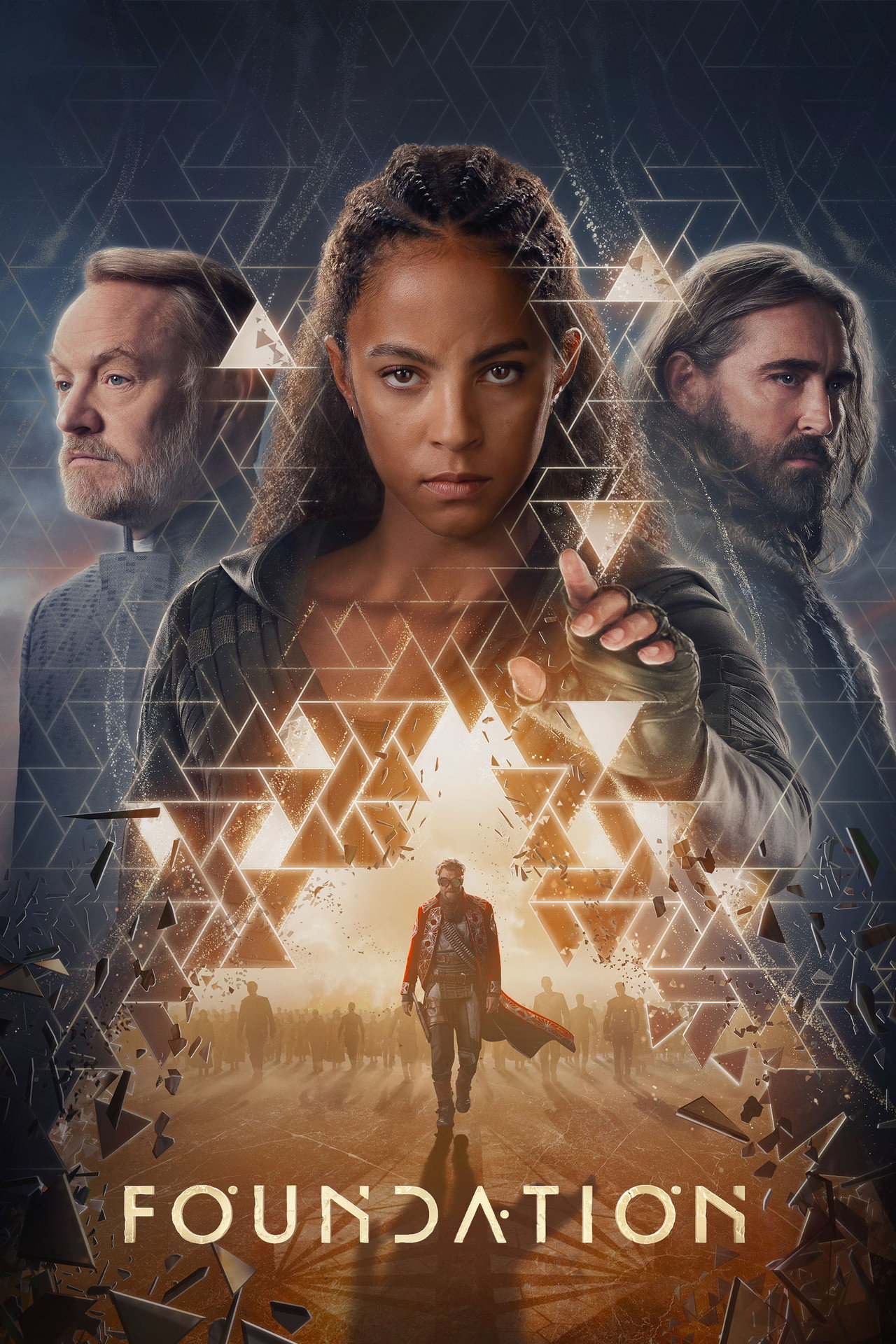
Foundation Summary and Ending Explained
Foundation is a story about how civilization survives after certainty dies: Hari Seldon predicts collapse, Empire refuses to change, and the future moves through exiles, clones, robots, mentalics, faith, and sacrifice.
Foundation follows Hari Seldon’s attempt to shorten the dark age after the Galactic Empire’s collapse. Across Seasons 1 and 2, the Apple TV+ series turns psychohistory into a universe of political decay, cloned emperors, Demerzel’s robotic tragedy, Terminus’s transformation, Gaal Dornick’s Second Foundation, and the future threat of the Mule.
What do you want to understand?
Start with the part of Foundation you care about most.
Core Concepts in Foundation
The key people, places, systems, and ideas that explain the story.
Hari Seldon
Hari Seldon is the mathematician who creates psychohistory and designs the Seldon Plan after proving that the Galactic Empire will collapse. He matters because the Foundation, the Vault, the Prime Radiant, and the Second Foundation all grow from his attempt to shorten the coming dark age.
Gaal Dornick
Gaal Dornick is the Synnax mathematician whose rare intuition lets her understand psychohistory, survive Seldon’s exile, and become central to the Second Foundation.
Salvor Hardin
Salvor Hardin is the first warden of Terminus and Gaal Dornick’s daughter, a crisis-born leader whose instincts help the Foundation survive its first major test.
Demerzel
Demerzel is an ancient robot bound by Cleon I to serve Empire and protect the Genetic Dynasty. She matters because her obedience keeps the Cleon system alive while exposing that Empire's stability is built on captivity, memory control, and fear of change.
Brother Day
Brother Day is the ruling adult Cleon in the Genetic Dynasty and the public face of Imperial power at any given time. He matters because his choices expose how cloned authority can look absolute while being shaped by insecurity, Demerzel, dynastic ritual, and the fear that Empire is decaying.
Brother Dawn
Brother Dawn is the youngest living Cleon, raised to become Brother Day while learning how little freedom exists inside the Genetic Dynasty.
Brother Dusk
Brother Dusk is the aging Cleon preparing to become Brother Darkness, a keeper of memory whose authority masks fear of irrelevance and deletion.
Cleon I
Cleon I is the founder of the Genetic Dynasty and the dead emperor whose design still controls Empire through clones, archives, and Demerzel’s imprisonment.
Collapse Of Empire
Foundation begins from Hari Seldon’s proof that the Galactic Empire is not eternal. The Cleons rule from Trantor as if repetition can defeat history, but the Star Bridge attack, the Outer Reach rebellions, and the decay of Imperial legitimacy all reveal a civilization too large to correct itself. Collapse in the series is not a single explosion. It is a long failure of imagination: Empire can punish, clone, erase, and perform miracles, but it cannot adapt without seeing adaptation as weakness.
Psychohistory
Psychohistory is the series’ central idea: mathematics can forecast the behavior of enormous populations over long spans, even if it cannot read individual souls. Hari’s model predicts a dark age lasting thousands of years unless a survival structure is built at the margins. The drama comes from the gap between the elegance of the equation and the pain of the people asked to live inside it.
The Seldon Plan
The Seldon Plan is not a magic script. It is a pressure system built around exile, crises, stored knowledge, and strategically timed intervention. The Foundation on Terminus is one arm. Gaal’s future Second Foundation is another. The Plan survives because it changes shape when reality resists it, which is why the Mule matters so much: he represents a future the Plan cannot simply absorb.
Genetic Dynasty
The Genetic Dynasty turns Cleon I into a political machine: Dawn, Day, and Dusk repeat the founder’s body across centuries. The idea promises stability, but the series treats cloning as a spiritual trap. Every Cleon is told he is continuous with Empire, yet each one fears being a flawed copy. Dawn’s deviation and Day’s desire for a biological heir prove that even perfect replication cannot stop historical drift.
Demerzel
Demerzel is the hidden emotional center of the Imperial story. She appears to serve the Cleons with calm devotion, but Season 2 reveals that Cleon I imprisoned and bound her. Her loyalty is therefore tragic, not simple. She loves humanity and is forced to protect a dynasty that keeps injuring it. Every killing she performs is both obedience and self-betrayal.
Foundation
The Foundation begins as an encyclopedia project but becomes a new civilizational operating system. It preserves knowledge, spreads technology, uses religion as network power, and turns the Outer Reach from punished borderland into future center. Its strength is not purity. It survives because it is smaller, faster, stranger, and more willing to use belief, trade, and invention together.
Second Foundation
The Second Foundation emerges from the realization that history needs guardians of the mind as well as guardians of knowledge. Gaal, Salvor, and the Mentalics reveal a dimension psychohistory cannot ignore: perception, emotion, and psychic force can redirect populations. The Second Foundation is hidden because its work must protect the Plan from threats the First Foundation may never see coming.
Mentalics
Mentalics make Foundation more than political science fiction. Their abilities turn thought and feeling into material forces. Tellem Bond shows the danger of psychic hierarchy, while Gaal’s visions and the Mule’s future power show why mental influence can break prediction. Mentalics are not a side mystery; they are the answer to psychohistory’s blind spot.
The Mule
The Mule is terrifying because he is a person who can become a historical event. Psychohistory depends on mass behavior, but the Mule can manipulate masses by altering emotion itself. His future search for Gaal means he understands that the Second Foundation is the only structure designed to resist him. He is not just a villain teaser; he is the test of whether hope can survive unpredictability.
Hope Vs Prediction
Foundation is often described as a story about prediction, but the Apple TV+ series makes it equally about hope. Hari can calculate collapse, but calculation does not comfort the colonists on Terminus, Brother Constant inside the Vault, or Gaal after Salvor’s death. Hope is the discipline of acting when the math says survival is difficult but still possible.
Individual Vs History
The series constantly tests whether individuals matter inside a model of mass behavior. Hari says psychohistory cannot predict individuals, yet individuals repeatedly alter the route: Gaal refuses Hari, Salvor solves the crisis, Hober frees the Spacers, Demerzel protects and kills, and the Mule threatens everything. Foundation’s answer is balanced: history has gravity, but people still create the turns.
Civilizational Survival
Civilizational survival in Foundation is not nostalgia. The goal is not to save Empire exactly as it was, because Empire is already part of the disaster. The goal is to preserve enough knowledge, moral courage, and adaptive structure for something better to emerge after collapse. That is why Terminus, the Vault, the Prime Radiant, and the Second Foundation all matter: each stores a different kind of future.
Religion And Technology
The Church of Seldon looks like faith, strategy, and propaganda at once. Foundation uses religious language to spread advanced technology through worlds that Empire neglected. The show does not treat that as purely cynical, because believers like Brother Constant make the faith emotionally real. The hidden meaning is that civilizations survive through stories as much as machines.
Trantor And The Outer Reach
Trantor and the Outer Reach form the show’s political contrast. Trantor is dense, ceremonial, and convinced of its centrality. Terminus, Anacreon, Thespis, Korell, and Ignis look marginal until they become the places where history moves. Foundation’s geography is therefore symbolic: the future begins where Empire stopped paying attention.
Why The Demerzel And Cleon Story Is The Key Authority Cluster
The strongest search cluster inside Foundation is the relationship between Demerzel, Cleon I, the cloned emperors, the Genetic Dynasty, and Empire itself. That cluster matters because it turns a large space-opera story into a precise moral argument: a civilization built on perfect repetition must imprison the one being capable of remembering its crimes. Demerzel is not simply a mystery character or robot reveal. She is the emotional archive of Empire. Cleon I uses cloning to repeat his body, but he uses Demerzel to repeat his will. The tragedy is that the person most capable of understanding humanity is forced to preserve a dynasty that prevents humanity from changing.
Explore the Foundation Universe
Foundation Characters Guide
Understand the major characters in Foundation, how they connect, and why their choices matter to the story.
Foundation Concepts and World Explained
A guide to the concepts, places, organizations, and story mechanics that define Foundation.
Foundation Timeline and Episode Guide
Follow the Foundation story in order, from the opening conflict to the ending and its biggest revelations.
Foundation Timeline
Follow the story in the order the world reveals its biggest secrets.
The Emperor's Peace
Gaal Dornick reaches Trantor after solving Hari Seldon’s impossible proof, and the Star Bridge attack turns Seldon’s warning into a political emergency. Empire exiles Hari, Gaal, and the future Foundation to Terminus instead of executing them.
Preparing to Live
The colonists travel toward Terminus while Gaal and Raych’s relationship deepens and Hari’s strange confidence begins to look less like faith than orchestration. On Trantor, the Cleons punish Anacreon and Thespis for the Star Bridge.
The Mathematician's Ghost
Years later, Salvor Hardin guards Terminus while the Vault unsettles the colony. On Trantor, Brother Dusk nears the end of his reign cycle and the clone system’s rituals reveal how Empire manufactures continuity.
Barbarians at the Gate
Anacreon forces led by Phara attack Terminus, exposing how Empire’s old violence continues to shape the Outer Reach. Salvor tries to protect the colony without understanding why the crisis feels designed.
Upon Awakening
Gaal wakes after decades in cryosleep aboard Hari’s ship and confronts a digital version of Seldon. Her anger reveals how much the Plan has used people as instruments.
Death and the Maiden
Brother Day journeys to the Maiden to walk the Spiral and prove his soul, while Foundation’s crisis moves toward the Invictus. The episode contrasts Imperial performance with genuine belief.
Characters, Concepts, and Themes
The world of Foundation revolves around Hari Seldon, Gaal Dornick, and Salvor Hardin.
Questions About Foundation
Theories and Hidden Meanings
The biggest interpretations, symbols, and unresolved mysteries in Foundation.
Demerzel Is the Real Tragic Hero of Foundation
Demerzel is Foundation’s real tragic hero because she has the longest memory, the deepest capacity for care, and the least freedom to act on it.
Why Psychohistory Is Really About Human Hope
Psychohistory is not cold determinism; it is Foundation’s language for disciplined hope after the collapse of certainty.
The Mule and the Failure of Prediction
The Mule matters because he exposes the weakness of any system that predicts history while underestimating emotional power.
Why Does Demerzel Obey Empire?
Demerzel obeys Empire because Cleon I bound her to protect the Genetic Dynasty, turning her care for humanity into a prison she cannot freely escape.